
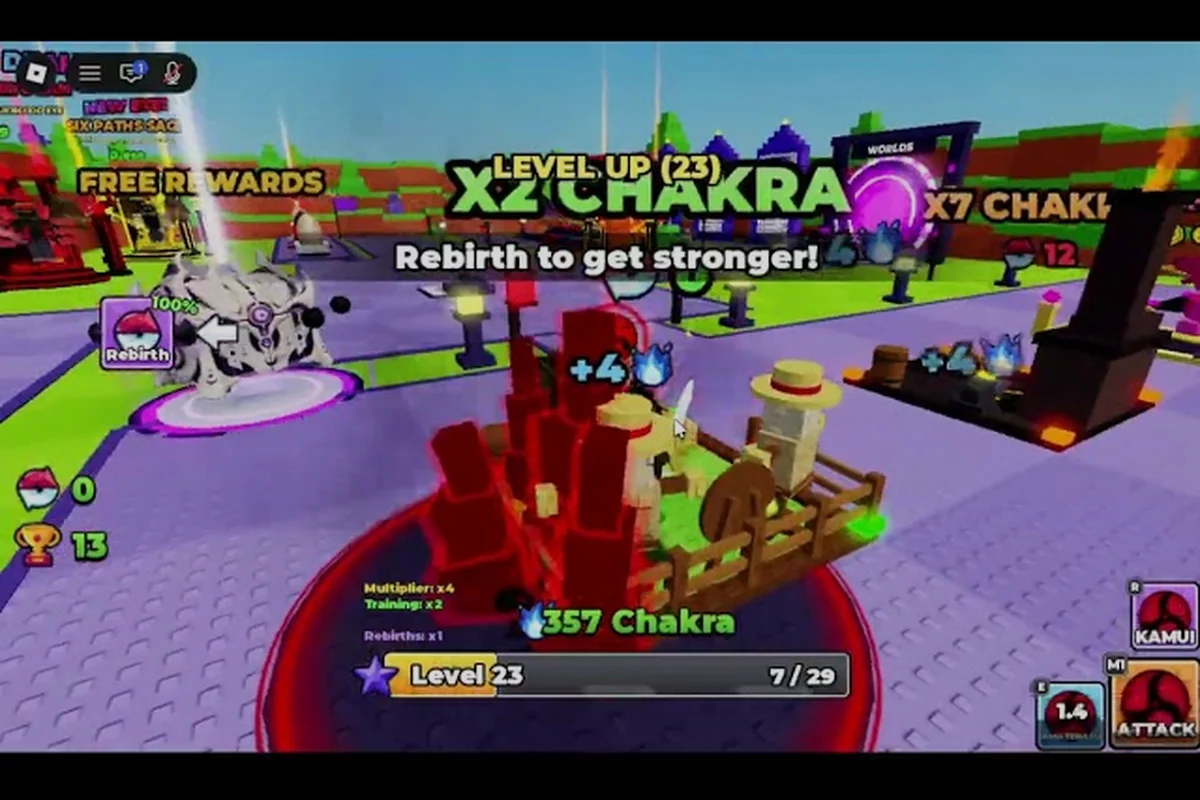
After a rebirth, the first question is not "which area is best in the game?" It is "which training route gets this account back to a useful state fastest?" Rebirth resets level and Chakra, keeps Wins, and grants a permanent multiplier. The rebuild is therefore a Chakra problem, and the best 1 anime eyes rebirth training spots are the ones that produce a measurable rate for your current setup.
This guide explains how to choose a rebuild route, how to measure it, and how to decide whether to reset again. It also qualifies the level 160 figure correctly: community coverage reports level 160 for the fifth rebirth, not as a universal requirement for every cycle.
What a rebirth training spot needs to do
A rebuild route has one job: restore the level and Chakra needed for the next cycle as efficiently as possible. It does not need to be the highest stage you have ever reached. It needs to be a stage or training setup you can repeat without long delays.
| Rebuild requirement | Why it matters | How to check |
|---|---|---|
| A measured Chakra rate | The reset removes your balance | Run a fixed session |
| A clearable route | Failed attempts waste the rebuild | Clear the route three times |
| An affordable training area | Chakra funds training | Compare price with recovery time |
| A realistic next requirement | The cycle needs an endpoint | Read the live rebirth panel |
| A Wins plan | Wins are retained but swords still cost Wins | Decide whether to farm Wins later |
The official game page lists 15 stages and the core systems. Community footage reports four worlds and high World 4 enemy health. The internal stage count of each world and the exact boss positions are not published, so do not treat a specific stage number as a guaranteed rebuild checkpoint.
Rebuild first, optimize second
The first few minutes after a reset are not the time to chase a perfect route. Pick a stage you can clear, confirm the pet and aura setup, and run a fixed session. Once the account is functional, compare a second route and keep the one with the better measured rate.
Measuring a rebuild route
A route is better when it produces more useful progress in the same time. Use a fixed session so the comparison is fair. Record the before-and-after values in a short note so the next decision rests on evidence rather than memory.
| Measurement | How to collect it | What it tells you |
|---|---|---|
| Chakra per fixed session | Gain in five minutes of normal play | The practical income rate |
| Clear time | Time to finish the stage | Whether damage is sufficient |
| Attempts needed | Tries before a clear | Whether the route is stable |
| Recovery time | Time to rebuild a spent balance | Whether the upgrade is affordable |
| Cycle time | Reset to the next requirement | Whether the rebirth loop improved |
Use the same route before and after a change
If you change the training area, the pet, or the stage, repeat the same measurement. A route that feels faster may simply be easier to reach. The recorded number is the evidence. That habit matters more than any single number copied from an older guide or a community summary.
Do not compare unlike sessions
A five-minute session with a new pet is not comparable to a twenty-minute session without it. Keep the duration and the route constant, then change one variable. This is the same discipline used in the training spots guide, applied to the post-reset context.
Chakra rate versus level progress
Chakra and level progress are related but not identical. Chakra funds training areas, eyes, and the rebuild. Level progress determines when the next rebirth becomes available. A route can be strong at one and weak at the other. If the result does not repeat, revert the change and test a different lever instead of spending more resources.
| Route type | Chakra strength | Level strength | Best use |
|---|---|---|---|
| Reliable early stage | Moderate | High if clears are fast | Restoring a baseline quickly |
| Higher stage with slow clears | Potentially high | Lower if attempts fail | Later in the cycle |
| Training-area focused | High | Depends on the area | Funding the next upgrade |
| Mixed route | Balanced | Balanced | General rebuilding |
Watch both numbers
If Chakra rises but the level barely moves, the route may not be producing enough clears. If the level rises but Chakra stays low, the route may be consuming resources without building a balance. Ideally, the rebuild route improves both at a useful pace.
The level 160 report and what it means
Community coverage reports that the fifth rebirth requires level 160. That is a specific reported case. It does not establish level 160 as the standard target for the first, second, or any other reset. The goal is a repeatable result, not a perfect run that cannot be reproduced on the next attempt.
| Rebirth reference | What is confirmed | How to plan |
|---|---|---|
| First rebirth | Live panel shows the requirement | Follow the displayed value |
| Fifth rebirth | Reported level 160 | Treat as a reported case |
| Other tiers | Not published | Read the live panel |
| Chakra cost | Displayed in the panel | Confirm you can pay it |
| Multiplier gain | Displayed in the panel | Compare with the rebuild time |
Do not build a route around a universal 160
A route that assumes every reset needs level 160 can waste time on a tier that needs something else. Read the live panel, record the actual requirement, and set the rebuild target from that value. If the panel shows 160 for your current tier, use it. If it does not, do not force it.
Deciding whether to rebirth again
A rebirth is worth considering when the requirement is met, the cost is affordable, and the rebuild will be shorter or stronger than the current cycle. It is not worth it when the account cannot recover within a reasonable session. A short written record also makes it easier to notice when a patch changes the behavior you measured.
| Current state | Likely decision | Reason |
|---|---|---|
| Requirement met, cost affordable, rebuild planned | Rebirth | The cycle can restart efficiently |
| Requirement met, cost affordable, no repair route | Delay | The next cycle may stall |
| Requirement not met | Continue training | Resetting is not available yet |
| Multiplier gain is small | Compare with the current cycle | A weak gain may not justify the reset |
| Close to a Trophy exchange | Finish the exchange first | Prevents an interrupted objective |
What a "rebirth skip" means
A rebirth skip is a decision to keep progressing without resetting, usually because the current cycle is still productive or the next multiplier is not worth the rebuild. It is not an exploit or a hidden menu option. It is a timing choice.
Use a skip when the current route is efficient and the next reset would cost more time than it saves. Do not use a skip as an excuse to avoid improving the account; if the current cycle is slow, fix the bottleneck before deciding.
A practical rebuild routine
A routine makes the post-reset period predictable. The sequence below uses only confirmed systems and your own measurements. Compare the new result with the old one before buying anything else, because a single change is easier to judge. This keeps the advice useful even after a balance update changes a price, a requirement, or a displayed multiplier.
| Step | Action | Record | Decision |
|---|---|---|---|
| 1 | Confirm aura, pet, and group | Active layers | Fix any inactive layer |
| 2 | Pick a clearable stage | Stage and clear time | Confirm the route is stable |
| 3 | Run a fixed session | Chakra gained | Establish the rebuild rate |
| 4 | Buy one upgrade | Price and displayed effect | Test whether it helps |
| 5 | Repeat the session | New Chakra gain | Keep or revert |
| 6 | Read the rebirth panel | Requirement and cost | Decide whether to reset |
Protect a Rebuild Buffer
Do not spend every Chakra on a training area during the rebuild. A reserve lets you test an upgrade and still recover. The reserve also makes the next reset less risky, because the account is not starting from zero with no plan.
Recheck the route after each cycle
The best rebuild route can change as the multiplier stack grows. A stage that was slow before a reset may become efficient after it. Recheck the route after each cycle rather than assuming the first choice is permanent. Use the live interface as the final authority whenever an older summary disagrees with what you can see.
Common rebuild mistakes
| Mistake | Why it hurts | Better approach |
|---|---|---|
| Assuming level 160 is universal | It is reported for the fifth rebirth | Read the live panel |
| Choosing the highest stage | It may fail often | Choose a repeatable route |
| Ignoring the Chakra rate | The rebuild has no clear measure | Run fixed sessions |
| Spending the whole balance | No reserve for the next test | Keep enough to recover |
| Resetting without a route | The next cycle stalls | Plan the first stage |
| Comparing unlike sessions | The result is misleading | Keep duration and route constant |
| Treating a skip as an exploit | It is a timing choice | Decide with cycle time |
Verify live values
The official listing was updated on October 30, 2026. Community footage from October 29, 2026 may already be outdated. Before a reset or a large purchase, read the live panels for the requirement, cost, multiplier, and training rate. In practice, the safest approach is to repeat the same test with one variable changed.
How the rebuild fits the wider progression
A rebuild is not separate from the rest of the game. It supports the Chakra you need for eyes, the training areas that raise your rate, and the stage clears that produce Wins and Trophies. Keep the result only when it holds across several attempts rather than a single lucky run.
| System | How the rebuild supports it | What the rebuild does not do |
|---|---|---|
| Eyes | Provides Chakra for the eye shop | Buy an eye directly |
| Training areas | Funds the next upgrade | Replace the area multiplier |
| Swords | Supports the sessions that produce Wins | Buy a sword tier |
| Trophies | Supports the stages that produce Trophies | Replace Trophy farming |
| Stage progress | Restores your capacity to clear stages | Unlock a world by itself |
The rebirth guide explains the reset rules, and the rebirth boost guide explains the multiplier stack. Use them with your own cycle records rather than a copied level chart. Record the before-and-after values in a short note so the next decision rests on evidence rather than memory.
Frequently Asked Questions
What are the best 1 anime eyes rebirth training spots?
The best spot is the route that produces the strongest measured Chakra rate and a reliable clear for your current setup. It is not necessarily the highest stage. Run a fixed session, compare two routes, and keep the one that rebuilds the account faster.
Is level 160 required for every rebirth?
No. Community coverage reports level 160 specifically for the fifth rebirth. Other tiers are not published. Read the live rebirth panel for your current requirement and do not generalize one reported case to every reset. That habit matters more than any single number copied from an older guide or a community summary.
Should I rebirth as soon as the requirement is met?
Usually, if the cost is affordable and you have a rebuild route. If the multiplier gain is small or the next cycle would stall, delay the reset. The decision should be based on the live panel and your own cycle time, not on a copied threshold.
What is a rebirth skip?
A rebirth skip is a choice to keep progressing without resetting because the current cycle is still productive or the next multiplier does not justify the rebuild. It is a timing decision, not an exploit or a hidden option. Use it when the current route is efficient.
Does the highest stage make the best rebuild route?
No. A higher stage can fail often and produce less progress than a lower stage you can clear consistently. Test both with the same session length and compare the Chakra gained, clear time, and level progress before choosing. If the result does not repeat, revert the change and test a different lever instead of spending more resources.